

On the afternoon of November 7, the sub-forum “Low-Carbon Energy Materials and Systems” of the Fifth International Young Scholars Forum of Shanghai Polytechnic University was held in Room 210, Building 28. The sub-forum was organized by the School of Energy and Materials. Twelve outstanding young scholars from renowned universities and research institutes, including De Montfort University in the UK, City University of Hong Kong, Tsinghua University, Shanghai Jiao Tong University, University of Science and Technology of China, ShanghaiTech University, South China University of Technology, Nanjing Tech University, Shanghai University, Donghua University, and Jiangsu Normal University, were invited to attend. Wang Yuanyuan, Dean of the School of Energy and Materials; Yu Wei, research lead; Xu Jianguang, Vice Dean; members of the school’s academic committee; and representatives of faculty and students attended the forum.
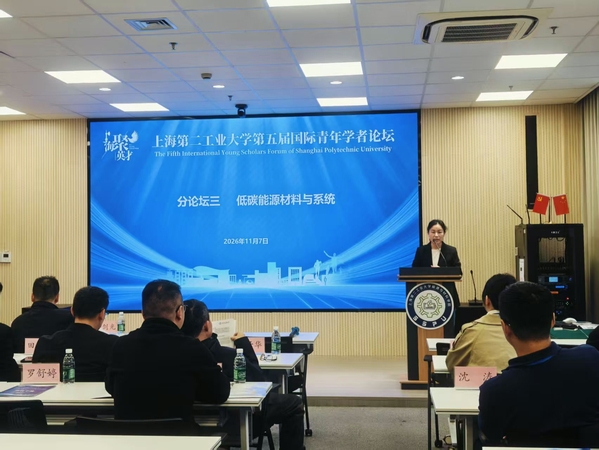
The forum was chaired by Wang Yuanyuan. On behalf of the school, she extended a warm welcome to the outstanding young scholars and introduced the school’s overall situation.
Subsequently, in the keynote report session, the 12 participating scholars gave presentations and exchanges on topics including low-carbon thermal energy storage and enhanced heat transfer; intelligent computing and screening of electrochemical energy storage materials; electrode design and interface regulation for zinc/sodium/potassium-ion and all-solid-state lithium batteries; ion migration in perovskite solar cells and optoelectronic thin-film materials; low-power micro/nano light sources; high-temperature dielectric energy storage polymers; multiphysics synchronous measurement based on luminescent sensing materials; and controllable fabrication of nanofiber materials for protective applications. The reports were cutting-edge and closely aligned with the direction of low-carbon energy materials and systems. The audience asked questions actively, and discussions were in depth.
The academic forum gave full play to its dual effectiveness in talent recruitment and academic exchange. It not only helped young scholars become familiar with the school’s platforms, teams, and research directions, but also created favorable conditions for introducing high-level talent, opening up pathways for interdisciplinary integration, and implementing substantive research cooperation.