
On the afternoon of August 24, to deepen industry-education integration and explore cross-sector collaborative innovation pathways in new energy and design, the School of Energy and Materials, together with the School of Art and Design, visited Shanghai Kaiyi Design Group Co., Ltd. for research and exchange. Wang Yuanyuan, Dean of the School of Energy and Materials, and Professor Yu Wei; Shen Fa, Dean of the School of Art and Design, and Zou Taotao, Vice Dean; Yu Ping, Deputy Director of the University’s Industry-Academia-Research Cooperation Office; and Quan Xianguo, Chairman of Kaiyi Group, attended the event. The two sides held in-depth discussions on the theme of “Architectural Carbon Neutrality and Urban Renewal Design Practice.” The exchange was chaired by Zou Taotao.
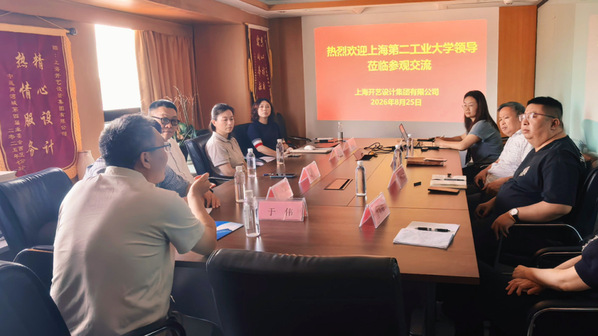
Quan Xianguo warmly received the university delegation and accompanied them throughout their visit to the Shanghai Modern Architectural Science and Technology Museum. At the symposium, Quan Xianguo introduced that the design industry is currently in a period of deep adjustment. As a long-established enterprise in the industry with three Class-A qualifications in architectural design, planning, and landscape architecture, Kaiyi Group is directly confronting the challenges of industry transformation. Two years ago, it proactively anchored its layout and upgrading in the “building new energy” track, comprehensively expanded emerging businesses such as photovoltaics and energy storage, and completed the groundwork for its transformation from a traditional design service provider to a comprehensive low-carbon solution provider. At the exchange, the group focused on introducing its core transformation carrier—the Hongqiao Kaiyi Building New Energy Technology Innovation Center project. The project is planned to be completed in 2027, with the goal of achieving a building energy self-sufficiency rate of more than 10%, far exceeding the average level of conventional projects. The project innovatively adopts a plan with PV panels fully covering all four walls and the roof, with differentiated PV products adapted to different orientations, including synchronous installation on the north shaded side. Internally, it implements a “one increase, two reductions, and three tables” management mechanism and uses a six-year investment payback as the project approval criterion to ensure efficient implementation.
Wang Yuanyuan introduced the school’s core strengths in discipline development, talent cultivation, and research breakthroughs. Closely aligned with the national “dual carbon” strategy and Shanghai’s industrial development needs, and rooted in the fields of new energy and new materials, the school has jointly built industry-education integration collaborative education practice bases with more than 30 large enterprises, including Shanghai Huahong and COMAC. The school emphasizes industry-education integration and university-enterprise collaborative innovation and has accumulated solid research foundations and technical advantages in directions such as new energy materials, thermal management technology, and PV-storage matching. The two sides reached pragmatic consensus on multi-dimensional university-enterprise cooperation: at the project cooperation level, the School of Energy and Materials will provide technical support in thermal management, PV-storage matching, PV panel operation and maintenance, and other directions, while the School of Art and Design will participate in PV-themed environmental design and cooperate on projects related to architectural urban renewal. The two sides established a lightweight and efficient cooperation model featuring “talent resource sharing and joint project bidding.”
At the meeting, both sides also proposed the idea of linking industrial resources in the Yangtze River Delta. Subsequently, they will establish a dedicated work coordination group, take the Hongqiao development project as the core pilot, and jointly create a demonstration model of “building new energy + environmental design,” laying a solid practical foundation for subsequent joint applications for research projects and expansion of the low-carbon design industry market. This research and exchange is another important practice of the School of Energy and Materials in deepening industry-education integration and serving the national “dual carbon” strategy. The school will continue to leverage its technical advantages in new energy and new materials, use university-enterprise cooperation as a key lever, promote the transformation of research outcomes into industrial applications, and contribute the strength of our university to green and low-carbon development.